 Greenly
How to care for burro's tail (Sedum morganianum)
Sedum morganianum · Donkey's tail, Donkey tail, Lamb's tail
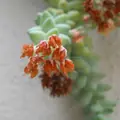
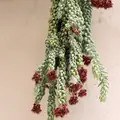
Burro's tail (Sedum morganianum) — a trailing succulent from southern Mexico whose stems, packed with plump, overlapping blue-green leaves under a silvery bloom, hang down like a braided tail, usually up to 60 cm and with age even longer; small pink to red star-shaped flowers appear at the tips in summer, though rarely indoors. Burro's tail needs full sun. Water it about every 14 days while it grows and about every 30 days in the winter rest.

Watering and repotting burro's tail through the year
It lives indoors all year, so it has no sowing or planting dates: it grows from March to September and rests from October to February (the other way round in the southern hemisphere).
Repot it about every 36 months.
When to plant burro's tail?
Plant or repot burro's tail in spring, as it starts into growth; early to midsummer also works. It is a houseplant, so it has no outdoor planting date and no frost decides it: just avoid autumn and winter, when growth slows and fresh compost stays wet too long. After that, move it to a slightly larger pot about every three years, or sooner once roots circle the pot or grow through the drainage holes.
Watering in the growing and resting halves of the year: Watering and repotting burro's tail through the year.
Sources: RHS: How to repot a plant · Penn State Extension: Repotting houseplants
Quick facts
| Type | Houseplant |
|---|---|
| Latin name | Sedum morganianum |
| Family | Crassulaceae |
| Also called | Donkey's tail, Donkey tail, Lamb's tail, Horse's tail |
| Light | Full sun |
| Frost | does not tolerate frost |
| Repotting | every 36 months |
| Grown in | At home |
Where does burro's tail grow?
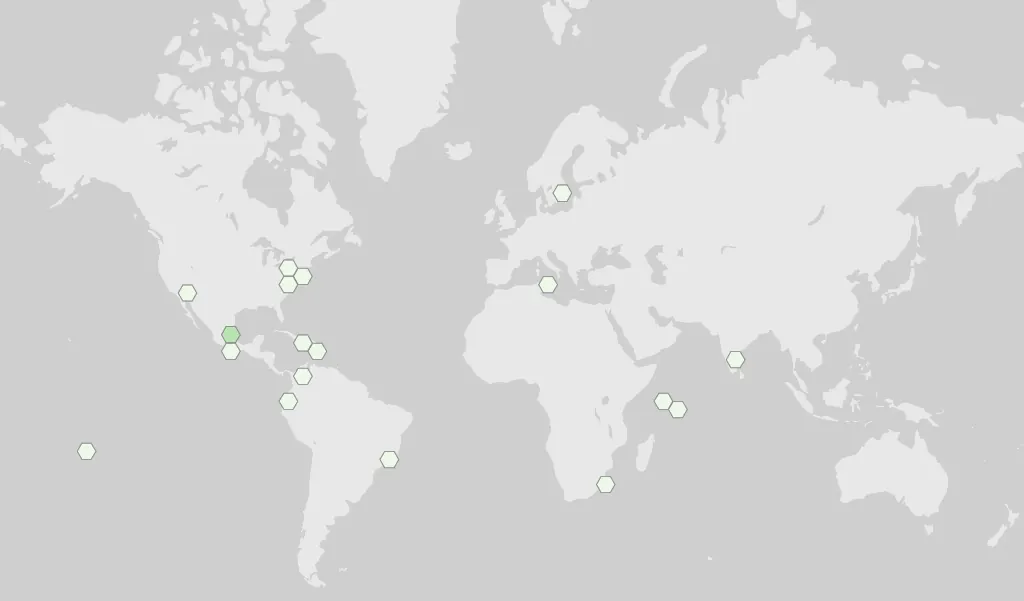
112 records of the plant in gardens, fields and the wild worldwide; most photos come from United States, Brazil, India, Italy, and Mexico.
Burro's tail care by growth stage
At home
| Stage | Watering | Temperature | Feeding |
|---|---|---|---|
| Growth | every 14 days | — | potassium, 44 days into the stage; potassium, 104 days into the stage |
| Winter rest | every 30 days | — | — |
Growing notes
Light
Bright light to full sun, such as a sunny window. In too little light the stems stretch and the leaves sit far apart; in very harsh light they bleach yellowish instead of blue-green.
Soil
Cactus mix, or loam-based compost with plenty of grit or perlite, in a shallow pot with drainage holes; avoid sand, which clogs the pores and slows drainage.
Care
Let the compost nearly dry out between waterings, using tepid water. Water regularly while it is growing, less from autumn, and in winter just enough to keep the compost from drying out completely; indoors that may be only once a month. Root rot from overwatering is the most common problem, and soft, limp leaves are its early sign. Feed lightly once or twice in the growing season. Repot in spring only when the plant has completely filled its pot, then wait about a week before watering. The stems are brittle and the leaves drop at a touch, so hang it out of the way; fallen leaves and stem cuttings root easily if left to dry for a day or two first. It can summer outdoors once nights stay above 4 °C, moved into the sun gradually. Watch for mealybugs, scale insects and vine weevil grubs. ASPCA lists it as non-toxic to cats, dogs and horses.
Pests and diseases of Burro's tail
2 problems are recorded for burro's tail; each has a page with symptoms, treatment and prevention.
Pests
Other plants of the Crassulaceae family
Burro's tail belongs to Crassulaceae; 4 other plants of this family have a guide here.
 Echeveria
 Jade Plant
 Kalanchoe
 Showy stonecrop
Plant lists it is in
Part of: Houseplants · Houseplants safe for cats and dogs · Houseplants for a sunny window · Houseplants that need little water
Sources
Figures checked against these sources.
- aspca.org/pet-care/animal-poison-control/toxic-and-non-toxic-plants/burros-tail
- plants.ces.ncsu.edu/plants/sedum-morganianum/
- gbif.org/species/5690408
- wikidata.org/wiki/Q2245759
- en.wikipedia.org/wiki/Sedum_morganianum
- uk.wikipedia.org/wiki/Sedum_morganianum
- ru.wikipedia.org/wiki/Очиток_Моргана
- es.wikipedia.org/wiki/Sedum_morganianum
- fr.wikipedia.org/wiki/Sedum_morganianum
- de.wikipedia.org/wiki/Sedum_morganianum
- pl.wikipedia.org/wiki/Rozchodnik_Morgana
- rhs.org.uk/plants/16969/sedum-morganianum/details
- hort.extension.wisc.edu/articles/burros-tail-sedum-morganianum/
- rhs.org.uk/plants/types/cacti-succulents/houseplants/growing-guide
