 Greenly
How to care for calla lily (Zantedeschia)
Zantedeschia · Calla
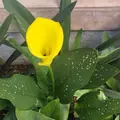
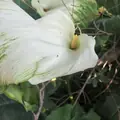
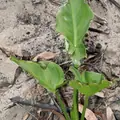
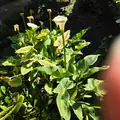
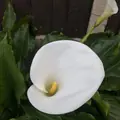
Calla lily (Zantedeschia) — a tender African plant grown from a rhizome, 30–75 cm tall, with glossy arrow-shaped leaves, often speckled white, and vase-shaped spathes in yellow, orange, pink, red, purple or white from late spring into summer. The pot callas are hybrids of Zantedeschia elliottiana and Z. rehmannii. Calla lily needs full sun. Water it about every 5 days while it grows.

Watering and repotting calla lily through the year
It lives indoors all year, so it has no sowing or planting dates: it grows from March to September and rests from October to February (the other way round in the southern hemisphere).
Repot it about every 12 months.
When to plant calla lily?
Plant or repot calla lily in spring, as it starts into growth; early to midsummer also works. It is a houseplant, so it has no outdoor planting date and no frost decides it: just avoid autumn and winter, when growth slows and fresh compost stays wet too long. After that, move it to a slightly larger pot about every year, or sooner once roots circle the pot or grow through the drainage holes.
Watering in the growing and resting halves of the year: Watering and repotting calla lily through the year.
Sources: RHS: How to repot a plant · Penn State Extension: Repotting houseplants
Quick facts
| Type | Houseplant |
|---|---|
| Latin name | Zantedeschia |
| Family | Araceae |
| Also called | Calla |
| Light | Full sun |
| Frost | does not tolerate frost |
| Repotting | every 12 months |
| Grown in | At home |
Where does calla lily grow?
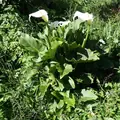
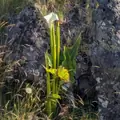
50,968 records of the plant in gardens, fields and the wild worldwide; most photos come from South Africa, New Zealand, Portugal, Australia, and United States.


Calla lily care by growth stage
At home
| Stage | Watering | Temperature | Feeding |
|---|---|---|---|
| Growth | every 5 days | — | balanced (NPK), 14 days into the stage; balanced (NPK), 28 days into the stage; balanced (NPK), 42 days into the stage; balanced (NPK), 56 days into the stage; balanced (NPK), 70 days into the stage; balanced (NPK), 84 days into the stage; balanced (NPK), 98 days into the stage; balanced (NPK), 112 days into the stage; balanced (NPK), 126 days into the stage; balanced (NPK), 140 days into the stage; balanced (NPK), 154 days into the stage; balanced (NPK), 168 days into the stage |
| Winter rest | — | — | — |
Growing notes
Light
Plenty of light; it grows in sun or partial shade but usually flowers best in full sun.
Soil
Multi-purpose or loam-based potting compost in a pot just a little larger than the rhizome. Set the rhizome near the surface, buds up and its top just showing. It needs better drainage than the white arum lily (Z. aethiopica), which grows even in pond margins.
Care
Start dormant rhizomes in a warm, bright place in early spring and water sparingly until shoots appear, usually within a couple of weeks; overwatered rhizomes rot. Once in full growth water regularly but never leave it standing in water, and feed with a balanced liquid fertiliser every two weeks until the flowers fade (a high-potash feed weekly while it flowers boosts flowering). Pull out faded flower stems at the base to get more. After flowering the leaves die down; then give it a winter rest with little or no water, ideally dark and frost-free, above 10 °C for a potted plant, and water again in spring when shoots show. Below 5 °C it can die. Under glass and indoors watch for aphids, red spider mites and whitefly. Large rhizomes can be cut into pieces, each with a bud, in spring. Toxic to cats and dogs — chewing it releases calcium oxalate crystals that cause drooling, mouth pain, pawing at the mouth and vomiting.
Pests and diseases of Calla lily
2 problems are recorded for calla lily; each has a page with symptoms, treatment and prevention.
Pests
Other plants of the Araceae family
Calla lily belongs to Araceae; 12 other plants of this family have a guide here.
 Syngonium
 Pothos
 Monstera
 Philodendron
 Dieffenbachia
 Anthurium
 Aglaonema
 Peace Lily
Plant lists it is in
Part of: Houseplants · Houseplants for a sunny window · Thirsty houseplants · Houseplants to repot every year
Sources
Figures checked against these sources.
- aspca.org/pet-care/aspca-poison-control/toxic-and-non-toxic-plants/calla-lily
- gbif.org/species/2868790
- rhs.org.uk/plants/zantedeschia/growing-guide
- wikidata.org/wiki/Q147043
- en.wikipedia.org/wiki/Zantedeschia
- uk.wikipedia.org/wiki/Зантедескія
- ru.wikipedia.org/wiki/Зантедеския
- es.wikipedia.org/wiki/Zantedeschia
- it.wikipedia.org/wiki/Zantedeschia
- fr.wikipedia.org/wiki/Zantedeschia
- fr.wikipedia.org/wiki/Zantedeschia_elliottiana
- pt.wikipedia.org/wiki/Zantedeschia
- de.wikipedia.org/wiki/Zantedeschien
- cs.wikipedia.org/wiki/Kala
- pl.wikipedia.org/wiki/Cantedeskia
- plants.ces.ncsu.edu/plants/zantedeschia/
- petpoisonhelpline.com/poison/calla-lily/
