 Greenly
How to care for lithops
Lithops · Living stones, Pebble plant, Stone plant
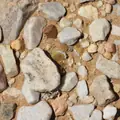
Lithops (Lithops) — tiny stemless succulents from southern Africa that mimic pebbles; each body is a single pair of thick, fused leaves with a slit across the top and translucent "windows", 1–2.5 cm tall and 2.5–7.5 cm wide. Yellow, white or pale orange daisy-like flowers open from the slit in autumn and early winter. Lithops needs full sun. Water it about every 21 days while it grows.

Watering and repotting lithops through the year
It lives indoors all year, so it has no sowing or planting dates: it grows from March to September and rests from October to February (the other way round in the southern hemisphere).
Repot it about every 60 months.
When to plant lithops?
Plant or repot lithops in spring, as it starts into growth; early to midsummer also works. It is a houseplant, so it has no outdoor planting date and no frost decides it: just avoid autumn and winter, when growth slows and fresh compost stays wet too long. After that, move it to a slightly larger pot about every five years, or sooner once roots circle the pot or grow through the drainage holes.
Watering in the growing and resting halves of the year: Watering and repotting lithops through the year.
Sources: RHS: How to repot a plant · Penn State Extension: Repotting houseplants
Quick facts
| Type | Houseplant |
|---|---|
| Latin name | Lithops |
| Family | Aizoaceae |
| Also called | Living stones, Pebble plant, Stone plant |
| Light | Full sun |
| Frost | does not tolerate frost |
| Repotting | every 60 months |
| Grown in | At home |
Where does lithops grow?
1,692 records of the plant in gardens, fields and the wild worldwide; most photos come from South Africa, Namibia, and Norway.

Lithops care by growth stage
At home
| Stage | Watering | Temperature | Feeding |
|---|---|---|---|
| Growth | every 21 days | — | — |
| Winter rest | — | — | — |
Growing notes
Light
Plenty of light, ideally about 4–5 hours of morning sun with afternoon shade, usually at a south or unobstructed east window. Short of light it stretches, leans, turns greenish and eventually dies; move it to brighter light gradually to avoid sunburn.
Soil
Cactus and succulent mix, or potting mix with extra sharp sand or perlite, in a pot 8–13 cm deep with drainage holes to fit the long roots; set the body just above the surface and top-dress with gravel.
Care
Its year runs differently from most houseplants, and watering at the wrong time is the main cause of death. Water from late spring into early summer; stop when it rests in mid-summer, giving only a little water to the top centimetre if it shrivels badly. Start again in late summer to early autumn, when the slit begins to open for flowering. After flowering keep it completely dry through winter and early spring while a new leaf pair grows inside the old one, and water again only once the old leaves have dried to a papery skin. Each time, soak the mix, let it dry out completely and wait a few more days; if in doubt, do not water. Too much water causes yellow, mushy or split leaves and rot. Feed sparingly during autumn growth with a low-nitrogen, high-potassium fertiliser. Give it fresh air in hot weather and never let it freeze. It can stay in the same pot for 10–20 years and live 40–50. Watch for mealybugs, spider mites and scale insects. ASPCA lists living stones as non-toxic to cats, dogs and horses.
Pests and diseases of Lithops
2 problems are recorded for lithops; each has a page with symptoms, treatment and prevention.
Pests
Plant lists it is in
Part of: Houseplants · Houseplants safe for cats and dogs · Flowering houseplants · Houseplants for a sunny window
Sources
Figures checked against these sources.
- aspca.org/pet-care/animal-poison-control/toxic-and-non-toxic-plants/living-stones
- plants.ces.ncsu.edu/plants/lithops/
- gbif.org/species/3231652
- wikidata.org/wiki/Q133283
- en.wikipedia.org/wiki/Lithops
- uk.wikipedia.org/wiki/Літопс
- ru.wikipedia.org/wiki/Литопс
- es.wikipedia.org/wiki/Lithops
- it.wikipedia.org/wiki/Lithops
- fr.wikipedia.org/wiki/Lithops
- pt.wikipedia.org/wiki/Lithops
- de.wikipedia.org/wiki/Lithops
- cs.wikipedia.org/wiki/Lithops
- pl.wikipedia.org/wiki/Litops
- rhs.org.uk/plants/25292/lithops/details
- hort.extension.wisc.edu/articles/living-stones-lithops/
- rhs.org.uk/plants/10367/lithops-lesliei/details
