 Greenly
How to grow peony (Paeonia lactiflora)
Paeonia lactiflora · garden peony, Chinese peony
When to plant peony?
Plant in autumn, about a month before your first autumn frost, so the roots grow before winter; it flowers or crops the next season.
Dates for your city are on the frost dates page.
Peony (Paeonia lactiflora) — herbaceous peony is a long-lived perennial grown for its large, often fragrant flowers in late spring and early summer; each plant blooms for about a week to ten days. It dies back to the ground every winter and regrows from its tuberous roots. Toxic to dogs, cats and horses. Peony grows best in full sun and soil with pH 6–7. Water it about every 7 days while it grows.

Quick facts
| Type | Flower |
|---|---|
| Latin name | Paeonia lactiflora |
| Family | Paeoniaceae |
| Also called | garden peony, Chinese peony |
| Planted as | divisions |
| Life span | perennial |
| Planting season | autumn |
| Light | Full sun |
| Soil pH | 6–7 |
| Frost | tolerates light frost |
| Growth starts | 165 days after planting |
| First flowers | 65 days after growth starts |
| Flowering lasts | 10 days |
| Grown in | Open ground |
How long does peony take from planting to flowering?
From planting to the first flowers: about 230 days, or 33 weeks.
| Step | Day |
|---|---|
| Planting | 0 |
| Growth starts | 165 |
| First flowers | 230 |
| End of flowering | 240 |
Days count from the day of sowing or planting, by the figures of the card.
Autumn feeding: what the garden needs in fall
UConn: do not feed in late summer or autumn. K-State: feed again in autumn after cutting back.
When to feed: Spring, with a mulch (RHS).
Where does peony grow?
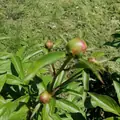
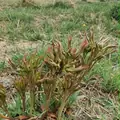
4,386 records of the plant in gardens, fields and the wild worldwide; most photos come from Russia, United States, China, Mongolia, and Czechia.




Peony care by growth stage
Open ground
| Stage | Watering | Temperature | Feeding |
|---|---|---|---|
| Growth | every 7 days | — | balanced (NPK), at the start of the stage |
| Flowering | every 7 days | — | balanced (NPK), 9 days into the stage |
Growing notes
Light
Does best in full sun, 6–8 hours of direct light a day; it tolerates light shade, but in too much shade it may not flower.
Soil
Fertile, well-drained soil improved with compost, pH 6.0–7.0. Grows in clay too, as long as the ground is not waterlogged in winter; standing water rots the roots.
Care
Plant divisions in autumn with the buds (eyes) no more than 2.5–5 cm below the surface — deeper planting is a common reason for no flowers. Give each plant about a square metre. Water in dry spells during the first year; established plants rarely need watering. Feed with a general fertiliser in spring and again straight after flowering, avoiding excess nitrogen. Stake heavy flowers and remove them when faded. Cut the foliage to the ground in autumn and remove it to reduce disease.
Pests and diseases of Peony
3 problems are recorded for peony; each has a page with symptoms, treatment and prevention.
Diseases
Plant lists it is in
Part of: Garden flowers · Perennial garden flowers
Sources
Figures checked against these sources.
- gbif.org/species/3083486
- en.wikipedia.org/wiki/Paeonia_lactiflora
- uk.wikipedia.org/wiki/Півонія_молочноквітова
- ru.wikipedia.org/wiki/Пион_молочноцветковый
- es.wikipedia.org/wiki/Paeonia_lactiflora
- missouribotanicalgarden.org/PlantFinder/PlantFinderDetails.aspx?kempercode=q400
- rhs.org.uk/plants/peony/herbaceous/growing-guide
- aspca.org/pet-care/animal-poison-control/toxic-and-non-toxic-plants/peony
- hort.extension.wisc.edu/articles/peony/
- johnson.k-state.edu/programs/lawn-garden/agent-articles-fact-sheets-and-more/agent-article
- edustore.purdue.edu/media/wysiwyg/downloads/pubs/HO/HO-76-W-A.pdf
- weather.gov/media/lsx/climate/stl/temp/temp_stl_freeze_data.pdf
- libguides.nybg.org/herbaceouspeonies
