 Greenly
How to care for chinese money plant (Pilea peperomioides)
Pilea peperomioides · Pilea, UFO plant, Pancake plant
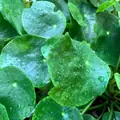
Chinese money plant (Pilea peperomioides) — a compact, clump-forming houseplant from the mountains of Yunnan in China with round, glossy, fleshy leaves up to 10 cm across, each held flat on a long stalk attached to its centre like a lily pad; usually 20–30 cm tall and as wide. Chinese money plant needs partial shade. Water it about every 7 days while it grows and about every 14 days in the winter rest.

Watering and repotting chinese money plant through the year
It lives indoors all year, so it has no sowing or planting dates: it grows from March to September and rests from October to February (the other way round in the southern hemisphere).
Repot it about every 24 months.
When to plant chinese money plant?
Plant or repot chinese money plant in spring, as it starts into growth; early to midsummer also works. It is a houseplant, so it has no outdoor planting date and no frost decides it: just avoid autumn and winter, when growth slows and fresh compost stays wet too long. After that, move it to a slightly larger pot about every two years, or sooner once roots circle the pot or grow through the drainage holes.
Watering in the growing and resting halves of the year: Watering and repotting chinese money plant through the year.
Sources: RHS: How to repot a plant · Penn State Extension: Repotting houseplants
Quick facts
| Type | Houseplant |
|---|---|
| Latin name | Pilea peperomioides |
| Family | Urticaceae |
| Also called | Pilea, UFO plant, Pancake plant, Missionary plant |
| Light | Partial shade |
| Frost | does not tolerate frost |
| Repotting | every 24 months |
| Grown in | At home |
Where does chinese money plant grow?
58 records of the plant in gardens, fields and the wild worldwide; most photos come from Belgium, Germany, Norway, and New Zealand.

Chinese money plant care by growth stage
At home
| Stage | Watering | Temperature | Feeding |
|---|---|---|---|
| Growth | every 7 days | — | balanced (NPK), 14 days into the stage; balanced (NPK), 74 days into the stage; balanced (NPK), 134 days into the stage; balanced (NPK), 194 days into the stage |
| Winter rest | every 14 days | — | — |
Growing notes
Light
Bright but indirect light near a north-, east- or west-facing window; in a south-facing room keep it back from the glass. Leaves flushed red-brown mean too much direct sun, leggy growth too little light.
Soil
Peat-free multi-purpose compost that stays moist but drains well, in a pot only a couple of centimetres larger than the root ball; an oversized pot stays wet and rots the roots.
Care
Water once the top few centimetres of compost start to dry, ideally with rainwater or filtered water, and tip away what collects in the saucer; it needs less in winter, and overwatering rots the roots. Avoid wetting the leaves, which can cause leaf spots. Turn the pot a quarter each time you water so it grows straight. Keep it above 10 °C, away from cold draughts and heaters. Feed with a balanced liquid fertiliser every month or two from April to September, without overfeeding. Check the roots each spring and repot when crowded, usually every couple of years. Pot up the offsets that appear around the base; a single leaf also roots in water. Watch for spider mites, scale insects, mealybugs and grey mould. ASPCA lists it as non-toxic to pets.
Pests and diseases of Chinese money plant
3 problems are recorded for chinese money plant; each has a page with symptoms, treatment and prevention.
Diseases
Pests
Plant lists it is in
Part of: Houseplants
Sources
Figures checked against these sources.
- plants.ces.ncsu.edu/plants/pilea-peperomioides/
- gbif.org/species/5669632
- wikidata.org/wiki/Q311696
- en.wikipedia.org/wiki/Pilea_peperomioides
- uk.wikipedia.org/wiki/Пілея_(рослина)
- ru.wikipedia.org/wiki/Пилея_пеперомиевидная
- es.wikipedia.org/wiki/Pilea_peperomioides
- it.wikipedia.org/wiki/Pilea
- fr.wikipedia.org/wiki/Pilea_peperomioides
- pt.wikipedia.org/wiki/Pilea
- de.wikipedia.org/wiki/Pilea_peperomioides
- cs.wikipedia.org/wiki/Pilea_peperomioides
- pl.wikipedia.org/wiki/Pilea_(roślina)
- rhs.org.uk/plants/13015/pilea-peperomioides/details
- rhs.org.uk/plants/pilea/how-to-grow-pilea
- aspca.org/news/are-succulents-safe-have-around-pets
