 Greenly
How to care for poinsettia (Euphorbia pulcherrima)
Euphorbia pulcherrima · Christmas star, Christmas flower
Poinsettia (Euphorbia pulcherrima) — shrub from Mexico and Guatemala sold in winter for its red, pink, white or marbled bracts, the coloured leaves around tiny yellow true flowers. As a pot plant it rarely grows taller than 60–90 cm. Poinsettia needs partial shade and 16–21 °C. Water it about every 5 days while it grows and about every 14 days in the winter rest.

Watering and repotting poinsettia through the year
It lives indoors all year, so it has no sowing or planting dates: it grows from March to September and rests from October to February (the other way round in the southern hemisphere).
Repot it about every 12 months.
When to plant poinsettia?
Plant or repot poinsettia in spring, as it starts into growth; early to midsummer also works. It is a houseplant, so it has no outdoor planting date and no frost decides it: just avoid autumn and winter, when growth slows and fresh compost stays wet too long. After that, move it to a slightly larger pot about every year, or sooner once roots circle the pot or grow through the drainage holes.
Watering in the growing and resting halves of the year: Watering and repotting poinsettia through the year.
Sources: RHS: How to repot a plant · Penn State Extension: Repotting houseplants
Quick facts
| Type | Houseplant |
|---|---|
| Latin name | Euphorbia pulcherrima |
| Family | Euphorbiaceae |
| Also called | Christmas star, Christmas flower |
| Light | Partial shade |
| Frost | does not tolerate frost |
| Repotting | every 12 months |
| Grown in | At home |
Where does poinsettia grow?
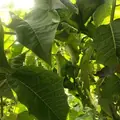
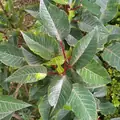
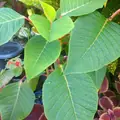
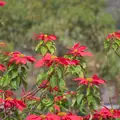
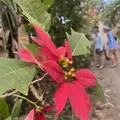
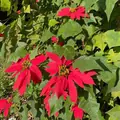
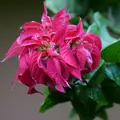
4,822 records of the plant in gardens, fields and the wild worldwide; most photos come from India, Mexico, Brazil, Spain, and Indonesia.

Poinsettia care by growth stage
At home
| Stage | Watering | Temperature | Feeding |
|---|---|---|---|
| Growth | every 5 days | 16…21 °C | balanced (NPK), 14 days into the stage; balanced (NPK), 35 days into the stage; balanced (NPK), 56 days into the stage; balanced (NPK), 77 days into the stage; balanced (NPK), 98 days into the stage; balanced (NPK), 119 days into the stage; balanced (NPK), 140 days into the stage; balanced (NPK), 161 days into the stage |
| Winter rest | every 14 days | — | — |
Growing notes
Light
At least six hours a day of bright, indirect light while it is in colour; direct sun can fade the bracts, so filter it with a sheer curtain, and keep the leaves off cold window panes. In summer it can stand outdoors in 6–8 hours of sun with some afternoon shade, after a week or two of getting used to it.
Soil
Well-drained potting mix with plenty of organic matter such as compost, leaf mould or peat moss. Repot each spring after cutting back, into a pot 5–10 cm larger. Take off the decorative foil when watering or punch holes in it; in waterlogged compost the roots and stems rot.
Care
Keep it at 16–21 °C, away from heaters, fires and draughts; below 10 °C it drops leaves, and a few minutes in freezing air on the way home blacken the bracts. Water thoroughly when the surface feels dry, never let it dry out completely, empty the saucer, and do not feed while it is in colour. Bought in colour it stays attractive for weeks to a couple of months. When about half the bracts and leaves have fallen, water less and rest it somewhere cool; in March cut the stems back to 10–15 cm, repot, and once new growth starts feed with a balanced fertiliser every 2–3 weeks. Outdoors in summer, pinch the shoot tips to keep it bushy, but not after the start of September, and bring it in when nights drop to 13–16 °C. To colour again for Christmas it needs 14 hours of complete darkness every night, in a cupboard or under a box, from early October for 8–10 weeks, with bright light by day and 16–21 °C; any stray light or nights above 21–24 °C delay colour and leave the bracts green. Watch for whitefly, mealybugs, soft scale and spider mites. The milky sap irritates skin and eyes and can affect people with a latex allergy; the ASPCA lists it as toxic to cats, dogs and horses, irritating the mouth and stomach and sometimes causing vomiting, but says its toxicity is generally overrated.
Pests and diseases of Poinsettia
3 problems are recorded for poinsettia; each has a page with symptoms, treatment and prevention.
Pests
Other plants of the Euphorbiaceae family
Poinsettia belongs to Euphorbiaceae; 2 other plants of this family have a guide here.
 Croton
 Crown of thorns
Plant lists it is in
Part of: Houseplants · Thirsty houseplants · Houseplants to repot every year
Sources
Figures checked against these sources.
- aspca.org/pet-care/animal-poison-control/toxic-and-non-toxic-plants/poinsettia
- gbif.org/species/3066465
- plants.ces.ncsu.edu/plants/euphorbia-pulcherrima/
- wikidata.org/wiki/Q208253
- en.wikipedia.org/wiki/Poinsettia
- uk.wikipedia.org/wiki/Молочай-різдвяник
- ru.wikipedia.org/wiki/Молочай_красивейший
- es.wikipedia.org/wiki/Euphorbia_pulcherrima
- it.wikipedia.org/wiki/Euphorbia_pulcherrima
- fr.wikipedia.org/wiki/Euphorbia_pulcherrima
- pt.wikipedia.org/wiki/Poinsétia
- de.wikipedia.org/wiki/Weihnachtsstern_(Pflanze)
- cs.wikipedia.org/wiki/Pryšec_nádherný
- pl.wikipedia.org/wiki/Wilczomlecz_nadobny
- hgic.clemson.edu/factsheet/poinsettia/
- yardandgarden.extension.iastate.edu/faq/how-do-i-care-poinsettia
- extension.illinois.edu/houseplants/caring-poinsettias
- yardandgarden.extension.iastate.edu/faq/what-should-i-do-my-poinsettia-after-holidays
- hort.extension.wisc.edu/dependable-durable-houseplants-copy-12-11-2025/
