 Greenly
How to care for amaryllis (Hippeastrum)
Hippeastrum · Hippeastrum, Knight's star lily
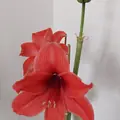
Amaryllis (Hippeastrum) — a large South American bulb (Hippeastrum hybrids, not the South African true amaryllis) that sends up a hollow stalk 45–60 cm tall with two to six trumpet flowers up to 15–25 cm long in red, pink, white or bicolours, followed by long strap-shaped leaves. Amaryllis needs full sun. Water it about every 7 days while it grows and about every 14 days in the winter rest.

Watering and repotting amaryllis through the year
It lives indoors all year, so it has no sowing or planting dates: it grows from March to September and rests from October to February (the other way round in the southern hemisphere).
Repot it about every 36 months.
When to plant amaryllis?
Plant or repot amaryllis in spring, as it starts into growth; early to midsummer also works. It is a houseplant, so it has no outdoor planting date and no frost decides it: just avoid autumn and winter, when growth slows and fresh compost stays wet too long. After that, move it to a slightly larger pot about every three years, or sooner once roots circle the pot or grow through the drainage holes.
Watering in the growing and resting halves of the year: Watering and repotting amaryllis through the year.
Sources: RHS: How to repot a plant · Penn State Extension: Repotting houseplants
Quick facts
| Type | Houseplant |
|---|---|
| Latin name | Hippeastrum |
| Family | Amaryllidaceae |
| Also called | Knight's star lily |
| Light | Full sun |
| Frost | does not tolerate frost |
| Repotting | every 36 months |
| Grown in | At home |
Where does amaryllis grow?
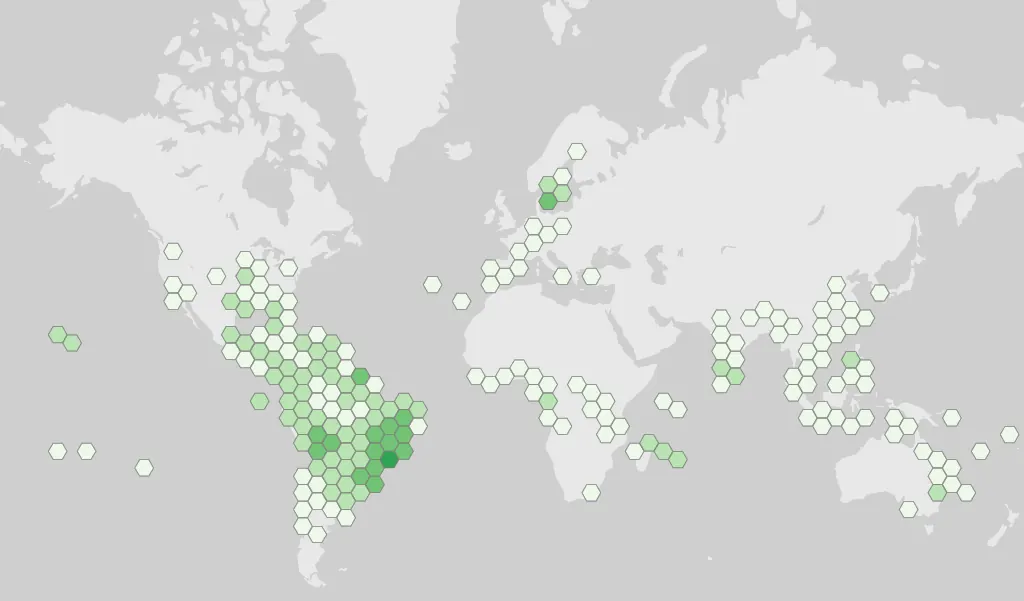
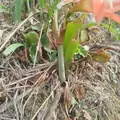
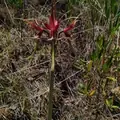
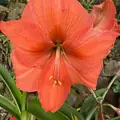
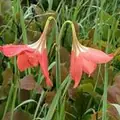
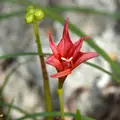
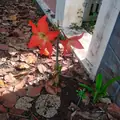
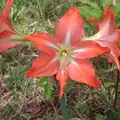
10,281 records of the plant in gardens, fields and the wild worldwide; most photos come from Brazil, Bolivia, Argentina, United States, and French Guiana.
Amaryllis care by growth stage
At home
| Stage | Watering | Temperature | Feeding |
|---|---|---|---|
| Growth | every 7 days | — | balanced (NPK), 14 days into the stage; balanced (NPK), 44 days into the stage; balanced (NPK), 74 days into the stage; balanced (NPK), 104 days into the stage; balanced (NPK), 134 days into the stage; balanced (NPK), 164 days into the stage; balanced (NPK), 194 days into the stage |
| Winter rest | every 14 days | — | — |
Growing notes
Light
A bright, sunny spot while it grows; shade the flowers from strong sun to make them last. Outdoors in summer, move it gradually from shade into full sun.
Soil
A well-drained potting mix rich in organic matter, in a pot only a little wider than the bulb, with the top half to two-thirds of the bulb above the surface. Repot every two or three years in late winter after flowering; it flowers well slightly pot-bound.
Care
A new bulb planted from October to January at about 21 °C flowers 6–8 weeks later; water sparingly until growth shows, then keep the mix just moist, never wet, turn the pot so the stalk grows straight and move the plant somewhere cooler (15–18 °C) to make the flowers last. Afterwards cut off the spent stalk but keep the leaves growing in bright light, watering regularly and feeding monthly; it can stand outdoors for the summer after the last frost. To flower again it needs a rest of 8–10 weeks from late September, either cool (about 13 °C) with little water and no feed, or dry in a cool dark place; then bring it back into warmth and light and water again, and it blooms 4–8 weeks later. Red spots and streaks on the stalk and leaves are red blotch, a fungal disease; look out for mealybugs. Toxic to pets if eaten, causing vomiting, drooling and in large amounts a drop in blood pressure and tremors; the bulb is the most dangerous part.
Other plants of the Amaryllidaceae family
Amaryllis belongs to Amaryllidaceae; 10 other plants of this family have a guide here.
 Clivia
 Wild garlic
 Daffodil
 Snowdrop
 Chives
 Leek
 Onion
 Shallot
Plant lists it is in
Part of: Houseplants · Flowering houseplants · Houseplants for a sunny window · Houseplants you rarely repot
Sources
Figures checked against these sources.
- aspca.org/pet-care/animal-poison-control/toxic-and-non-toxic-plants/amaryllis
- plants.ces.ncsu.edu/plants/hippeastrum/
- gbif.org/species/2854235
- hort.extension.wisc.edu/articles/amaryllis-hippeastrum/
- wikidata.org/wiki/Q757257
- en.wikipedia.org/wiki/Hippeastrum
- uk.wikipedia.org/wiki/Гіпеаструм
- ru.wikipedia.org/wiki/Гиппеаструм
- es.wikipedia.org/wiki/Hippeastrum
- it.wikipedia.org/wiki/Hippeastrum
- fr.wikipedia.org/wiki/Hippeastrum
- pt.wikipedia.org/wiki/Hippeastrum
- de.wikipedia.org/wiki/Rittersterne
- cs.wikipedia.org/wiki/Hvězdník
- pl.wikipedia.org/wiki/Zwartnica
- rhs.org.uk/plants/hippeastrum/growing-guide
- rhs.org.uk/plants/63784/hippeastrum-bestseller/details
- petpoisonhelpline.com/poison/amaryllis/
