 Greenly
How to care for Clivia miniata
Clivia miniata · Natal lily, Bush lily
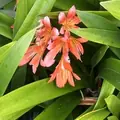
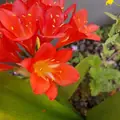
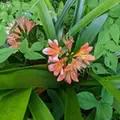
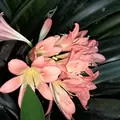
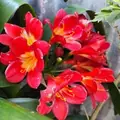
Clivia (Clivia miniata) — an evergreen South African plant with a fan of long, leathery, strap-shaped leaves and a thick stalk topped by a cluster of 12–20 funnel-shaped orange flowers with yellow throats; about 45–60 cm tall. Clivia needs partial shade. Water it about every 10 days while it grows and about every 21 days in the winter rest.

Watering and repotting clivia through the year
It lives indoors all year, so it has no sowing or planting dates: it grows from March to September and rests from October to February (the other way round in the southern hemisphere).
Repot it about every 48 months.
When to plant clivia?
Plant or repot clivia in spring, as it starts into growth; early to midsummer also works. It is a houseplant, so it has no outdoor planting date and no frost decides it: just avoid autumn and winter, when growth slows and fresh compost stays wet too long. After that, move it to a slightly larger pot about every four years, or sooner once roots circle the pot or grow through the drainage holes.
Watering in the growing and resting halves of the year: Watering and repotting clivia through the year.
Sources: RHS: How to repot a plant · Penn State Extension: Repotting houseplants
Quick facts
| Type | Houseplant |
|---|---|
| Latin name | Clivia miniata |
| Family | Amaryllidaceae |
| Also called | Natal lily, Bush lily |
| Light | Partial shade |
| Frost | does not tolerate frost |
| Repotting | every 48 months |
| Grown in | At home |
Where does clivia grow?
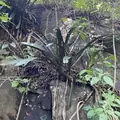
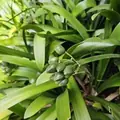
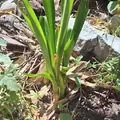
612 records of the plant in gardens, fields and the wild worldwide; most photos come from South Africa, New Zealand, Portugal, Germany, and Australia.

Clivia care by growth stage
At home
| Stage | Watering | Temperature | Feeding |
|---|---|---|---|
| Growth | every 10 days | — | balanced (NPK), 14 days into the stage; balanced (NPK), 44 days into the stage; balanced (NPK), 74 days into the stage; balanced (NPK), 104 days into the stage; balanced (NPK), 134 days into the stage; balanced (NPK), 164 days into the stage; balanced (NPK), 194 days into the stage |
| Winter rest | every 21 days | — | — |
Growing notes
Light
Bright, filtered light, such as a north window or an east or west window shaded from the sun. Direct summer sun scorches the leaves; in low light it grows but rarely flowers.
Soil
A free-draining, organic-rich potting mix. It flowers best with crowded roots, so repot only every three to five years, in early spring, into a pot just a few centimetres larger, keeping the neck above the compost.
Care
From spring to autumn water regularly, letting the surface dry between waterings, and feed monthly at half strength. To flower it needs a rest from about November to February in a cool, bright room at about 10 °C, with just enough water to stop the leaves wilting and no feed; a winter that is too warm gives flowers hidden on short stalks among the leaves. In March bring it back to about 16 °C and water more; it flowers from late winter into spring. Soggy compost rots the fleshy roots. Cut the whole flower stalk off at the base after flowering, wearing gloves because the sap irritates skin. Offsets with three or four leaves can be potted up on their own. Toxic to cats and dogs; the bulb-like base is the most poisonous part.
Pests and diseases of Clivia
2 problems are recorded for clivia; each has a page with symptoms, treatment and prevention.
Diseases
Pests
Other plants of the Amaryllidaceae family
Clivia belongs to Amaryllidaceae; 10 other plants of this family have a guide here.
 Amaryllis
 Wild garlic
 Daffodil
 Snowdrop
 Chives
 Leek
 Onion
 Shallot
Plant lists it is in
Part of: Houseplants · Flowering houseplants · Houseplants you rarely repot
Sources
Figures checked against these sources.
- aspca.org/pet-care/aspca-poison-control/toxic-and-non-toxic-plants/clivia-lily
- plants.ces.ncsu.edu/plants/clivia-miniata/
- gbif.org/species/9482657
- wikidata.org/wiki/Q149094
- wikidata.org/wiki/Q1163100
- en.wikipedia.org/wiki/Clivia_miniata
- uk.wikipedia.org/wiki/Клівія
- ru.wikipedia.org/wiki/Кливия_киноварная
- es.wikipedia.org/wiki/Clivia_miniata
- it.wikipedia.org/wiki/Clivia_miniata
- fr.wikipedia.org/wiki/Clivia_miniata
- pt.wikipedia.org/wiki/Clivia
- de.wikipedia.org/wiki/Klivie
- cs.wikipedia.org/wiki/Řemenatka_červená
- pl.wikipedia.org/wiki/Kliwia_cynobrowa
- rhs.org.uk/plants/clivia/how-to-grow
- hort.extension.wisc.edu/articles/clivia/
- rhs.org.uk/plants/4036/clivia-miniata/details
