 Greenly
How to care for pink jasmine (Jasminum polyanthum)
Jasminum polyanthum · many-flowered jasmine, Chinese jasmine
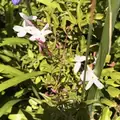
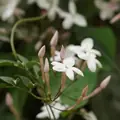
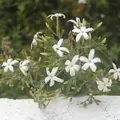
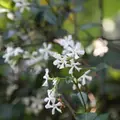
Pink Jasmine (Jasminum polyanthum) — vigorous evergreen twining climber from south-west China with dark green leaves of 5–7 leaflets and, in late winter and spring, masses of very fragrant white star-shaped flowers opening from pink buds. Grown as a houseplant or up a trellis in a conservatory. Pink Jasmine needs partial shade. Water it about every 5 days while it grows and about every 12 days in the winter rest.

Watering and repotting pink jasmine through the year
It lives indoors all year, so it has no sowing or planting dates: it grows from March to September and rests from October to February (the other way round in the southern hemisphere).
Repot it about every 24 months.
When to plant pink jasmine?
Plant or repot pink jasmine in spring, as it starts into growth; early to midsummer also works. It is a houseplant, so it has no outdoor planting date and no frost decides it: just avoid autumn and winter, when growth slows and fresh compost stays wet too long. After that, move it to a slightly larger pot about every two years, or sooner once roots circle the pot or grow through the drainage holes.
Watering in the growing and resting halves of the year: Watering and repotting pink jasmine through the year.
Sources: RHS: How to repot a plant · Penn State Extension: Repotting houseplants
Quick facts
| Type | Houseplant |
|---|---|
| Latin name | Jasminum polyanthum |
| Family | Oleaceae |
| Also called | many-flowered jasmine, Chinese jasmine |
| Light | Partial shade |
| Frost | does not tolerate frost |
| Repotting | every 24 months |
| Grown in | At home |
Where does pink jasmine grow?
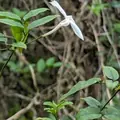
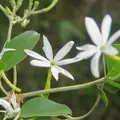
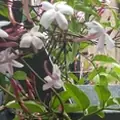
2,631 records of the plant in gardens, fields and the wild worldwide; most photos come from New Zealand, Australia, Spain, South Africa, and United States.

Pink Jasmine care by growth stage
At home
| Stage | Watering | Temperature | Feeding |
|---|---|---|---|
| Growth | every 5 days | — | potassium, 14 days into the stage; potassium, 35 days into the stage; potassium, 56 days into the stage; potassium, 77 days into the stage; potassium, 98 days into the stage; potassium, 119 days into the stage; potassium, 140 days into the stage; potassium, 161 days into the stage |
| Winter rest | every 12 days | — | — |
Growing notes
Light
Bright, filtered light with little or no direct sun, which makes the flowers open and fade too quickly. In summer it can stand outdoors in a warm, sheltered spot, moved gradually from shade into sun.
Soil
Peat-free, loam-based potting compost that drains freely; it does not tolerate soggy compost. Pot on every two to three years in spring into a pot 5–10 cm wider.
Care
Water regularly while it grows, letting the top centimetre of compost dry first, and only lightly in winter. From early spring to early autumn feed every 2–4 weeks with a high-potassium liquid feed, such as tomato fertiliser, at half the label rate, then stop. Flower buds form in late summer, so stop pruning by early August. Sources differ on cold. White Flower Farm, a nursery that grows it, gives it 4–5 weeks of nights at 4–10 °C in early autumn, with plenty of daylight and no artificial light after dark, to set buds; the RHS rates it tender and advises keeping it above 13 °C. Either way, bring it in before frost. Cool rooms make the flowers last longer, while radiators and hot-air vents dry it out, so stand the pot on a tray of damp pebbles. After flowering, thin out overcrowded growth. Propagate by semi-ripe cuttings in summer or by layering in autumn. Indoors watch for mealybugs, red spider mites, scale insects and aphids. The ASPCA lists jasmine (Jasminum) as non-toxic to cats, dogs and horses.
Pests and diseases of Pink Jasmine
2 problems are recorded for pink jasmine; each has a page with symptoms, treatment and prevention.
Pests
Other plants of the Oleaceae family
Pink Jasmine belongs to Oleaceae; 3 other plants of this family have a guide here.
 Common privet
 Lilac
 Forsythia
Plant lists it is in
Part of: Houseplants · Flowering houseplants · Thirsty houseplants
Sources
Figures checked against these sources.
- rhs.org.uk/plants/jasmine/growing-guide
- gbif.org/species/3682631
- rhs.org.uk/plants/9457/jasminum-polyanthum/details
- wikidata.org/wiki/Q282635
- en.wikipedia.org/wiki/Jasminum_polyanthum
- uk.wikipedia.org/wiki/Жасмин
- ru.wikipedia.org/wiki/Жасмин_многоцветковый
- es.wikipedia.org/wiki/Jasminum_polyanthum
- it.wikipedia.org/wiki/Jasminum_polyanthum
- fr.wikipedia.org/wiki/Jasminum_polyanthum
- pt.wikipedia.org/wiki/Jasminum_polyanthum
- de.wikipedia.org/wiki/Jasminum
- cs.wikipedia.org/wiki/Jasmín
- pl.wikipedia.org/wiki/Jaśmin
- rhs.org.uk/plants/types/houseplants/winter-interest-houseplants-care
- chicagobotanic.org/plant-information/plant-finder/jasminum-polyanthum-pink-jasmine
- rhs.org.uk/plants/types/houseplants/growing-guide
- whiteflowerfarm.com/how-to-grow-caring-for-jasmine-plants-indoors
- aspca.org/pet-care/animal-poison-control/toxic-and-non-toxic-plants/jasmine
