 Greenly
How to grow lilac
Syringa vulgaris · common lilac
When to plant lilac?
Planted as a young plant from a nursery while it is dormant — in early spring before the buds open, or in autumn after leaf fall.
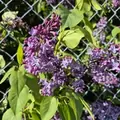
Lilac (Syringa vulgaris) — deciduous, suckering shrub from southeastern Europe grown for its very fragrant flower panicles in May. It reaches 3.5–5 m tall and does best where summers are cool and winters cold. Lilac grows best in full sun and soil with pH 6–7. Water it about every 7 days while it grows.

Quick facts
| Type | Shrub |
|---|---|
| Latin name | Syringa vulgaris |
| Family | Oleaceae |
| Also called | common lilac |
| Planted as | young plants from a nursery |
| Life span | perennial |
| Light | Full sun |
| Soil pH | 6–7 |
| Frost | tolerates light frost |
| Flowering | about 26 days after the last spring frost |
| Flowering lasts | 10 days |
| Pruning | right after flowering (it flowers on last year’s shoots) |
| Grown in | Open ground |
Autumn feeding: what the garden needs in fall
No feeding; too much nitrogen gives leaves instead of flower buds.
When to feed: After flowering, and only if a soil test shows a need.
Where does lilac grow?
171,264 records of the plant in gardens, fields and the wild worldwide; most photos come from France, Germany, United States, United Kingdom, and Canada.







Lilac care by growth stage
Open ground
| Stage | Watering | Temperature | Feeding |
|---|---|---|---|
| Growth | every 7 days | — | — |
| Flowering | every 7 days | — | balanced (NPK), 10 days into the stage |
| Winter rest | — | — | — |
Growing notes
Light
At least six hours of direct sun a day; in too much shade it flowers poorly or not at all.
Soil
Well-drained soil rich in organic matter, pH 6.0–7.0; the roots rot where water cannot drain.
Care
Water right after planting and two or three times a week for the first month, then give about 2.5 cm of water a week. Do not feed in the first year; later feed only if a soil test shows a need, after flowering. Prune right after flowering, before next year's buds form, and remove faded blooms within a week. Remove root suckers and every one to three years cut about a third of the thickest stems at ground level.
Pests and diseases of Lilac
1 problem is recorded for lilac; it has a page with symptoms, treatment and prevention.
Diseases
Other plants of the Oleaceae family
Lilac belongs to Oleaceae; 3 other plants of this family have a guide here.
 Common privet
 Forsythia
 Pink Jasmine
Plant lists it is in
Part of: Shrubs to prune after flowering
Sources
Figures checked against these sources.
- gbif.org/species/5415039
- wikidata.org/wiki/Q6565319
- missouribotanicalgarden.org/PlantFinder/PlantFinderDetails.aspx?taxonid=282932
- weather.gov/media/lsx/climate/stl/temp/temp_stl_freeze_data.pdf
- barron.extension.wisc.edu/files/2023/02/Lilacs-for-Cold-Climates.pdf
- extension.unh.edu/blog/2019/08/fall-good-time-plant-trees-shrubs
