 Greenly
Pear rust: how to recognise and treat it
Disease · Also called: European pear rust, pear trellis rust
Pear rust is a plant disease. It affects pear and common juniper. Bright orange spots on the upper side of pear leaves in summer and early autumn.

Key facts
| Type | Disease |
|---|---|
| Urgency | medium — the treatment plan starts the next day |
| Plants affected | 2 |
| Plant families | Cupressaceae, Rosaceae |
| Symptoms described | 4 |
| Treatment options | organic and chemical (3 organic steps, 1 chemical) |
| Prevention measures | 3 |
| Sources | 9 |
Symptoms of pear rust
- Bright orange spots on the upper side of pear leaves in summer and early autumn.
- Brown acorn-shaped growths up to 6 mm tall under the leaf spots.
- On juniper, swellings on stems and branches that push out orange jelly-like masses in wet spring weather.
- The fungus needs both pear and juniper to complete its life cycle.
How to treat pear rust
Organic treatment
- Cut out infected juniper branches or remove infected junipers near pears.
- Prune out cankers on pear branches.
- Do not strip heavily infected pear leaves; losing them harms the tree more than the rust.
Chemical treatment
- Fungicide with myclobutanil on pears from the pink bud stage in spring; follow the label dose and pre-harvest interval.
Reference information, not a guarantee. Read and follow the label of any product: dose, safety and the days to wait before harvest.
How to prevent pear rust
- Do not plant susceptible junipers such as Juniperus sabina, J. chinensis or J. scopulorum near pears.
- Choose J. communis, J. horizontalis or J. squamata, which are immune or highly resistant.
- Buy rust-free juniper plants.
Which plants are affected by pear rust?
2 plants are listed for pear rust; all have a guide and belong to 2 families.
Cupressaceae
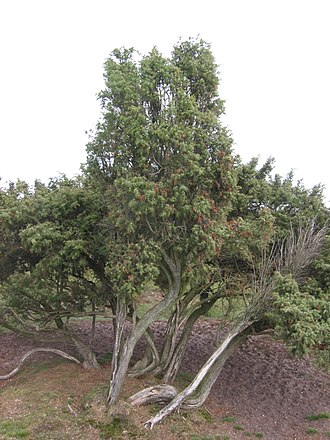 Common juniper
Rosaceae
 Pear
Pests and diseases by plant
What else affects the same plants as pear rust?
- Rust (Disease, shares 2 plants): Pale spots on the upper leaf surface, with raised powdery pustules mostly underneath; on beans they often have a yellow halo.
- Scale insects (Pest, shares 2 plants): Small round or oval bumps on stems and along leaf veins, mostly underneath, that do not move and look like shells or scabs.
- Apple scab (Disease, shares 1 plant): Olive-green, velvety spots or blotches on the leaves in spring and summer.
- Black rot and frogeye leaf spot (Disease, shares 1 plant): Small purple leaf spots grow into round "frogeye" spots with a purple rim and a brown or tan centre.
- Black-veined white (Pest, shares 1 plant): In winter, nests of a few dry leaves spun together with silk hang in the crown, each holding dozens of small caterpillars.
- Boron deficiency (Deficiency, shares 1 plant): Hollow stems and browning heads or curds in cabbage, cauliflower and broccoli.
Sources
Figures checked against these sources.
- rhs.org.uk/disease/pear-rust
- pnwhandbooks.org/plantdisease/host-disease/pear-pyrus-spp-trellis-rust-european-pear-rust
- pnwhandbooks.org/plantdisease/host-disease/juniper-juniperus-spp-pear-trellis-rust
- plagas.itacyl.es/roya-del-peral
- ru.wikipedia.org/wiki/Ржавчина_груши
- agrarii-razom.com.ua/plant-diseases/irja-grushi
- it.wikipedia.org/wiki/Gymnosporangium_sabinae
- fr.wikipedia.org/wiki/Rouille_grillagée_du_poirier
- en.wikipedia.org/wiki/Gymnosporangium_sabinae