 Greenly
How to care for bunny ears cactus (Opuntia microdasys)
Opuntia microdasys · Angel's wings, Polka-dot cactus
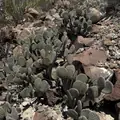
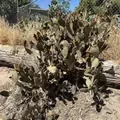
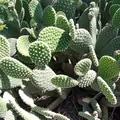
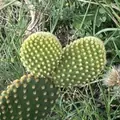
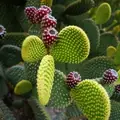
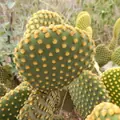
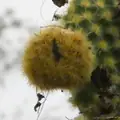
Bunny ears cactus (Opuntia microdasys) — a clump-forming cactus from Mexico with flat, oval pads up to 15 cm across that have no spines but are dotted with tufts of golden-yellow or white bristles (glochids); new pads often grow in pairs, like rabbit ears. Bunny ears cactus needs full sun. Water it about every 14 days while it grows and about every 30 days in the winter rest.

Watering and repotting bunny ears cactus through the year
It lives indoors all year, so it has no sowing or planting dates: it grows from March to September and rests from October to February (the other way round in the southern hemisphere).
Repot it about every 36 months.
When to plant bunny ears cactus?
Plant or repot bunny ears cactus in spring, as it starts into growth; early to midsummer also works. It is a houseplant, so it has no outdoor planting date and no frost decides it: just avoid autumn and winter, when growth slows and fresh compost stays wet too long. After that, move it to a slightly larger pot about every three years, or sooner once roots circle the pot or grow through the drainage holes.
Watering in the growing and resting halves of the year: Watering and repotting bunny ears cactus through the year.
Sources: RHS: How to repot a plant · Penn State Extension: Repotting houseplants
Quick facts
| Type | Houseplant |
|---|---|
| Latin name | Opuntia microdasys |
| Family | Cactaceae |
| Also called | Angel's wings, Polka-dot cactus |
| Light | Full sun |
| Frost | does not tolerate frost |
| Repotting | every 36 months |
| Grown in | At home |
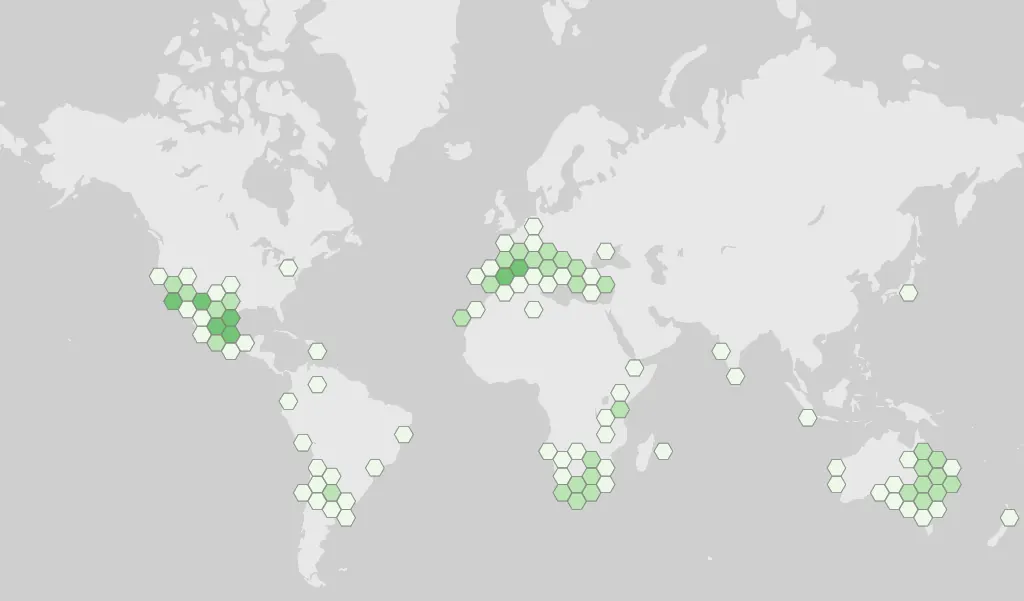
Where does bunny ears cactus grow?
2,800 records of the plant in gardens, fields and the wild worldwide; most photos come from Mexico, United States, Spain, South Africa, and France.

Bunny ears cactus care by growth stage
At home
| Stage | Watering | Temperature | Feeding |
|---|---|---|---|
| Growth | every 14 days | — | balanced (NPK), 14 days into the stage; balanced (NPK), 64 days into the stage; balanced (NPK), 114 days into the stage; balanced (NPK), 164 days into the stage |
| Winter rest | every 30 days | 10…18 °C | — |
Growing notes
Light
Full sun all year, such as a sunny south- or west-facing window; it tolerates partial shade but grows best in strong light.
Soil
Sharply draining cactus compost, or loam-based compost with added sharp sand, in a pot with drainage holes.
Care
The glochids are barbed and come off at the slightest touch, lodging in skin and eyes; wear gloves or hold pads with folded newspaper. In spring, summer and early autumn let the compost dry out completely before watering again, and feed three or four times with a balanced liquid fertiliser. In winter keep it cool, at 10–18 °C, with no feed and almost no water; poor drainage and overwatering cause root and stem rot. It rarely flowers indoors. Root a detached pad in well-drained compost in spring or summer. Look out for mealybugs and scale insects. ASPCA lists Opuntia species as non-toxic to cats and dogs.
Pests and diseases of Bunny ears cactus
1 problem is recorded for bunny ears cactus; it has a page with symptoms, treatment and prevention.
Pests
Other plants of the Cactaceae family
Bunny ears cactus belongs to Cactaceae; 6 other plants of this family have a guide here.
 Mammillaria
 Mistletoe cactus
 Christmas Cactus
 Chin cactus
 Easter cactus
 Dragon fruit
Plant lists it is in
Part of: Houseplants · Houseplants for a sunny window · Houseplants that need little water · Houseplants for a cool room
Sources
Figures checked against these sources.
- plants.ces.ncsu.edu/plants/opuntia-microdasys/
- gbif.org/species/7283961
- rhs.org.uk/plants/11881/opuntia-microdasys/details
- wikidata.org/wiki/Q310523
- en.wikipedia.org/wiki/Opuntia_microdasys
- uk.wikipedia.org/wiki/Список_видів_роду_опунція
- ru.wikipedia.org/wiki/Опунция_мелковолосистая
- es.wikipedia.org/wiki/Opuntia_microdasys
- it.wikipedia.org/wiki/Opuntia
- fr.wikipedia.org/wiki/Opuntia_microdasys
- pt.wikipedia.org/wiki/Opuntia
- de.wikipedia.org/wiki/Opuntia_microdasys
- cs.wikipedia.org/wiki/Opuncie
- pl.wikipedia.org/wiki/Opuncja_drobnokolczasta
- rhs.org.uk/plants/types/cacti-succulents/houseplants/growing-guide
- aspca.org/pet-care/animal-poison-control/toxic-and-non-toxic-plants/tree-cactus
