 Greenly
How to care for mistletoe cactus (Rhipsalis baccifera)
Rhipsalis baccifera · Rhipsalis, Spaghetti cactus
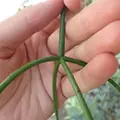
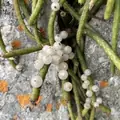
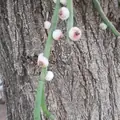
Mistletoe cactus (Rhipsalis baccifera) — a leafless, spineless rainforest cactus that grows on trees in the wild, with masses of thin, cylindrical, pale green stems about 5 mm thick that hang like green spaghetti, indoors up to about 1.8 m long; small white flowers in late winter and spring are followed by white or pale pink berries like mistletoe. Mistletoe cactus needs partial shade. Water it about every 7 days while it grows and about every 14 days in the winter rest.

Watering and repotting mistletoe cactus through the year
It lives indoors all year, so it has no sowing or planting dates: it grows from March to September and rests from October to February (the other way round in the southern hemisphere).
Repot it about every 36 months.
When to plant mistletoe cactus?
Plant or repot mistletoe cactus in spring, as it starts into growth; early to midsummer also works. It is a houseplant, so it has no outdoor planting date and no frost decides it: just avoid autumn and winter, when growth slows and fresh compost stays wet too long. After that, move it to a slightly larger pot about every three years, or sooner once roots circle the pot or grow through the drainage holes.
Watering in the growing and resting halves of the year: Watering and repotting mistletoe cactus through the year.
Sources: RHS: How to repot a plant · Penn State Extension: Repotting houseplants
Quick facts
| Type | Houseplant |
|---|---|
| Latin name | Rhipsalis baccifera |
| Family | Cactaceae |
| Also called | Rhipsalis, Spaghetti cactus |
| Light | Partial shade |
| Frost | does not tolerate frost |
| Repotting | every 36 months |
| Grown in | At home |
Where does mistletoe cactus grow?
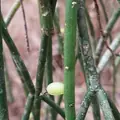
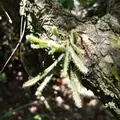
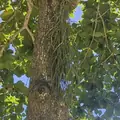
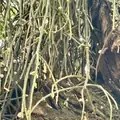
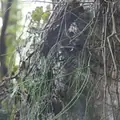
10,392 records of the plant in gardens, fields and the wild worldwide; most photos come from Madagascar, Mexico, Brazil, Gabon, and Nicaragua.

Mistletoe cactus care by growth stage
At home
| Stage | Watering | Temperature | Feeding |
|---|---|---|---|
| Growth | every 7 days | — | phosphorus and potassium, 14 days into the stage; phosphorus and potassium, 44 days into the stage; phosphorus and potassium, 74 days into the stage; phosphorus and potassium, 104 days into the stage; phosphorus and potassium, 134 days into the stage; phosphorus and potassium, 164 days into the stage; phosphorus and potassium, 194 days into the stage |
| Winter rest | every 14 days | — | — |
Growing notes
Light
Bright, indirect light, such as an east- or west-facing window, or a south one behind a net curtain. Direct sun scorches the stems.
Soil
Epiphytic cactus compost that is gritty, slightly acidic and free-draining yet holds some moisture.
Care
Unlike desert cacti it likes steadier moisture; water moderately whenever the compost feels dry while it is growing and keep it just moist in winter, never soggy, since overwatering leads to mushy stems and root rot. Stems that pucker and go limp are thirsty; brown tips mean too little water or humidity. It likes high humidity, so mist it with soft water or stand it on a tray of wet pebbles, and keep it at about 16–27 °C. Feed monthly while it is growing with a dilute low-nitrogen fertiliser. A summer outdoors in partial shade hardens the stems and encourages flowering. Long stems can be trimmed for a bushier plant and root easily as cuttings in spring or summer. Watch for mealybugs, spider mites and aphids, and for fungal diseases in very humid air. ASPCA lists it as non-toxic to cats, dogs and horses.
Pests and diseases of Mistletoe cactus
1 problem is recorded for mistletoe cactus; it has a page with symptoms, treatment and prevention.
Pests
Other plants of the Cactaceae family
Mistletoe cactus belongs to Cactaceae; 6 other plants of this family have a guide here.
 Mammillaria
 Bunny ears cactus
 Christmas Cactus
 Chin cactus
 Easter cactus
 Dragon fruit
Plant lists it is in
Part of: Houseplants · Houseplants safe for cats and dogs · Houseplants you rarely repot
Sources
Figures checked against these sources.
- aspca.org/pet-care/animal-poison-control/toxic-and-non-toxic-plants/mistletoe-cactus
- gbif.org/species/3084036
- wikidata.org/wiki/Q136525
- wikidata.org/wiki/Q132296
- en.wikipedia.org/wiki/Rhipsalis_baccifera
- uk.wikipedia.org/wiki/Рипсаліс
- ru.wikipedia.org/wiki/Рипсалис
- es.wikipedia.org/wiki/Rhipsalis_baccifera
- it.wikipedia.org/wiki/Rhipsalis_baccifera
- fr.wikipedia.org/wiki/Rhipsalis_baccifera
- pt.wikipedia.org/wiki/Rhipsalis_baccifera
- de.wikipedia.org/wiki/Rhipsalis_baccifera
- pl.wikipedia.org/wiki/Rhipsalis
- plants.ces.ncsu.edu/plants/rhipsalis-baccifera/
- rhs.org.uk/plants/14483/rhipsalis-baccifera/details
- rhs.org.uk/plants/types/cacti-succulents/houseplants/growing-guide
