 Greenly
How to grow freesia
Freesia
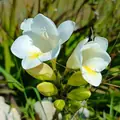
Freesia (Freesia) — corm plant from southern Africa with narrow, sword-shaped leaves and wiry stems 30–60 cm tall, each carrying a one-sided row of 5–10 strongly scented, funnel-shaped flowers in white, yellow, orange, pink, red, lavender or purple. A favourite long-lasting cut flower. Freesia grows best in full sun. Water it about every 7 days while it grows.

When to plant freesia?
Plant the bulbs straight into the bed after your last spring frost, once the soil has warmed.
In an unheated greenhouse everything moves about three weeks earlier.
It flowers about 56 days after growth starts and keeps flowering for about 60 days.
Quick facts
| Type | Flower |
|---|---|
| Latin name | Freesia |
| Family | Iridaceae |
| Planted as | bulbs |
| Life span | perennial |
| Planting season | spring |
| Light | Full sun |
| Frost | does not tolerate frost |
| Soil for planting | from 5 °C |
| Growth starts | 21 days after planting |
| First flowers | 56 days after growth starts |
| Flowering lasts | 60 days |
| Grown in | Greenhouse, Open ground, At home |
How long does freesia take from planting to flowering?
From planting to the first flowers: about 77 days, or 11 weeks.
| Step | Day |
|---|---|
| Planting | 0 |
| Growth starts | 21 |
| First flowers | 77 |
| End of flowering | 137 |
Days count from the day of sowing or planting, by the figures of the card.
Where does freesia grow?
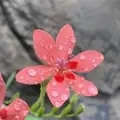
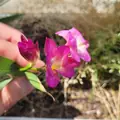
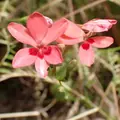
13,653 records of the plant in gardens, fields and the wild worldwide; most photos come from South Africa, Australia, New Zealand, Spain, and France.

Freesia care by growth stage
Greenhouse
| Stage | Watering | Temperature | Feeding |
|---|---|---|---|
| Growth | every 3 days | — | balanced (NPK), 14 days into the stage; balanced (NPK), 28 days into the stage; balanced (NPK), 42 days into the stage |
| Flowering | every 3 days | — | potassium, at the start of the stage; potassium, 14 days into the stage; potassium, 28 days into the stage; potassium, 42 days into the stage; potassium, 56 days into the stage |
Open ground
| Stage | Watering | Temperature | Feeding |
|---|---|---|---|
| Growth | every 7 days | — | balanced (NPK), 14 days into the stage; balanced (NPK), 28 days into the stage; balanced (NPK), 42 days into the stage |
| Flowering | every 7 days | — | potassium, at the start of the stage; potassium, 14 days into the stage; potassium, 28 days into the stage; potassium, 42 days into the stage; potassium, 56 days into the stage |
At home
| Stage | Watering | Temperature | Feeding |
|---|---|---|---|
| Growth | every 3 days | — | balanced (NPK), 14 days into the stage; balanced (NPK), 28 days into the stage; balanced (NPK), 42 days into the stage |
| Flowering | every 3 days | — | potassium, at the start of the stage; potassium, 14 days into the stage; potassium, 28 days into the stage; potassium, 42 days into the stage; potassium, 56 days into the stage |
Growing notes
Light
Full sun in a warm, sheltered spot, such as by a house wall; where summers are hot, morning sun and afternoon shade. It flowers best with cool nights.
Soil
Moist but well-drained, sandy or organic-rich soil with a neutral pH. In pots use potting compost with coarse sand or grit, in a deep pot for the long roots; wet soil rots the corms.
Care
In cold climates plant prepared corms outside in April, 5 cm deep and 5–8 cm apart, pointed end up, and push in twiggy sticks for support; they flower in July and August. Freesias survive only a few degrees of frost and grow best cool, at 10–15 °C; heat makes them spindly and the flowers fade fast. Water as needed while in growth. Feed every two weeks with a liquid fertiliser once the shoots are about 15 cm tall, and with a high-potassium feed once buds show. Cut faded stems at the base, keep watering and feeding until the leaves turn yellow, then stop. Lift the corms before frost and store them dry and warm. Increase them from offsets; seedlings take a few years to flower. In mild areas plant in August–September for spring flowers; pots planted in late summer flower indoors in winter. Watch for aphids, spider mites, slugs, grey mould, sclerotinia and fusarium wilt.
Pests and diseases of Freesia
4 problems are recorded for freesia; each has a page with symptoms, treatment and prevention.
Diseases
Pests
Other plants of the Iridaceae family
Freesia belongs to Iridaceae; 4 other plants of this family have a guide here.
 Gladiolus
 Crocus
 Bearded Iris
 Saffron
Plant lists it is in
Part of: Garden flowers · Perennial garden flowers · Summer bulbs and tubers
Sources
Figures checked against these sources.
- gbif.org/species/2747044
- wikidata.org/wiki/Q157392
- en.wikipedia.org/wiki/Freesia
- uk.wikipedia.org/wiki/Фрезія
- ru.wikipedia.org/wiki/Фрезия
- es.wikipedia.org/wiki/Freesia
- it.wikipedia.org/wiki/Freesia
- fr.wikipedia.org/wiki/Freesia
- pt.wikipedia.org/wiki/Freesia
- de.wikipedia.org/wiki/Freesien
- cs.wikipedia.org/wiki/Frézie
- pl.wikipedia.org/wiki/Frezja
- plants.ces.ncsu.edu/plants/freesia/
- rhs.org.uk/plants/freesia/growing-guide
