 Greenly
How to grow black-eyed Susan (Rudbeckia hirta)
Rudbeckia hirta · Rudbeckia
When to sow black-eyed susan?
Sow for seedlings about 9 weeks before planting out.
Plant out in open ground about a week after your last spring frost, once the soil is warm.
It flowers about 100 days after the shoots appear and keeps flowering for about 90 days.
Black-eyed Susan (Rudbeckia hirta) — a tough daisy-like flower with golden-yellow rays around a dark brown cone, 0.6–1.2 m tall. A short-lived perennial or biennial that flowers in its first year from an early spring sowing, so it is often grown as an annual; it blooms from midsummer into autumn and attracts pollinators. Black-eyed Susan grows best in full sun. Water it about every 7 days while it grows.

Quick facts
| Type | Flower |
|---|---|
| Latin name | Rudbeckia hirta |
| Family | Asteraceae |
| Also called | Rudbeckia |
| Planted as | seed |
| How it is started | from seedlings |
| Life span | perennial |
| Planting season | spring |
| Light | Full sun |
| Frost | does not tolerate frost |
| Soil for sowing | from 10 °C |
| Germination | 12 days |
| Pricking out | 21 days after the shoots appear |
| Seedlings ready | 50 days |
| First flowers | 100 days after the shoots appear |
| Flowering lasts | 90 days |
| Grown in | Open ground |
How long does black-eyed Susan take from sowing to flowering?
From sowing to the first flowers: about 112 days, or 16 weeks.
| Step | Day |
|---|---|
| Sowing | 0 |
| Shoots appear | 12 |
| Pricking out | 33 |
| Seedlings ready to plant out | 62 |
| First flowers | 112 |
| End of flowering | 202 |
Days count from the day of sowing or planting, by the figures of the card.
Where does black-eyed susan grow?
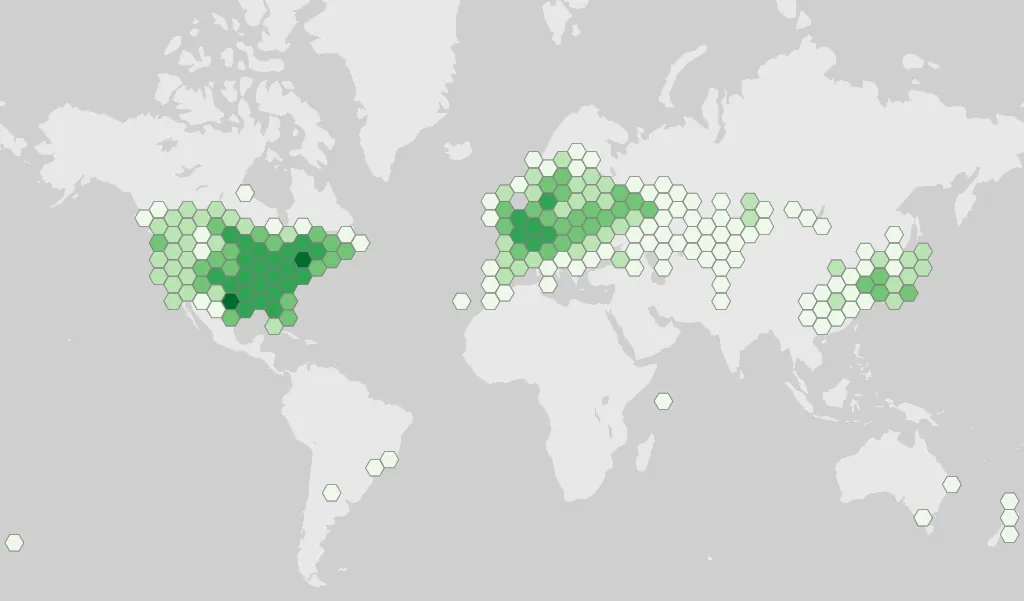
81,880 records of the plant in gardens, fields and the wild worldwide; most photos come from United States, Canada, France, Germany, and Russia.

Black-eyed Susan care by growth stage
Open ground
| Stage | Watering | Temperature | Feeding |
|---|---|---|---|
| Seedlings | every 2 days | — | — |
| Growth | every 7 days | — | balanced (NPK), at the start of the stage; balanced (NPK), 49 days into the stage |
| Flowering | every 7 days | — | — |
Growing notes
Light
Best in full sun, more than 6 hours a day; it tolerates partial shade.
Soil
Moist, well-drained clay, loam or sandy soil; it is not fussy about pH. Moderate fertility gives the best flowers — too much nitrogen does not help.
Care
Sow indoors 8–10 weeks before the last frost; seedlings appear in about two weeks. Plant out after the last frost, 30–60 cm apart (plants spread 30–60 cm). Keep the soil evenly moist until the plants settle in; after that they tolerate drought and heat. Feed lightly when growth starts. Deadhead to keep it flowering, and cut the dead stems back between autumn and early spring. It self-seeds freely. Powdery mildew, leaf spots, aphids and slugs are the usual problems.
Pests and diseases of Black-eyed Susan
4 problems are recorded for black-eyed Susan; each has a page with symptoms, treatment and prevention.
Black-eyed Susan: all pests and diseases with photos
Diseases
Pests
Other plants of the Asteraceae family
Black-eyed Susan belongs to Asteraceae; 20 other plants of this family have a guide here.
 Sunflower
 Cosmos
 Calendula
 Purple coneflower
 Marigold
 Zinnia
 Dahlia
 China aster
Part of: Garden flowers · Perennial garden flowers · Long-flowering plants · Flowers to start from seedlings
Sources
Figures checked against these sources.
- gbif.org/species/3114225
- en.wikipedia.org/wiki/Rudbeckia_hirta
- uk.wikipedia.org/wiki/Рудбекія_шорстка
- ru.wikipedia.org/wiki/Рудбекия_волосистая
- plants.ces.ncsu.edu/plants/rudbeckia-hirta/
- hgic.clemson.edu/factsheet/rudbeckia/
- yardandgarden.extension.iastate.edu/how-to/germination-requirements-annuals-and-vegetables
- umass.edu/agriculture-food-environment/home-lawn-garden/fact-sheets/fertilizing-flower-gar
