 Greenly
How to grow almond
Prunus amygdalus · almond tree
When to plant almond?
Planted as a young plant from a nursery while it is dormant — in early spring before the buds open, or in autumn after leaf fall.
Harvest from August to September (northern hemisphere).
Almond (Prunus amygdalus) — a nut tree related to the peach, grown for its almonds, harvested in August and September. It flowers before the leaves, at the time spring frosts still come, needs 400–500 hours of winter chill and a second cultivar for cross-pollination. Almond grows best in full sun. Water it about every 7 days while it grows.

Quick facts
| Type | Fruit tree |
|---|---|
| Latin name | Prunus amygdalus |
| Family | Rosaceae |
| Also called | almond tree |
| Planted as | young plants from a nursery |
| Life span | perennial |
| Light | Full sun |
| Frost | tolerates light frost |
| First harvest after planting | about 4 years |
| Flowering | about 20 days before the last spring frost |
| Flowering lasts | 12 days |
| Harvest months | August to September (northern hemisphere) |
| Pruning | in late winter, before growth starts |
| Grown in | Open ground |
Where does almond grow?
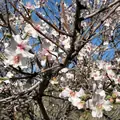
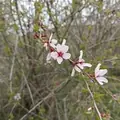
21,948 records of the plant in gardens, fields and the wild worldwide; most photos come from Spain, France, United States, Portugal, and Greece.



Almond care by growth stage
Open ground
| Stage | Watering | Temperature | Feeding |
|---|---|---|---|
| Growth | every 7 days | — | nitrogen, at the start of the stage |
| Flowering | every 7 days | — | — |
| Fruiting | every 7 days | — | — |
| Harvest | every 7 days | — | — |
| Winter rest | — | — | — |
Growing notes
Light
Full sun for at least three quarters of the day.
Soil
Deep, well-drained soil, ideally a fertile sandy loam; almonds will not tolerate wet soils.
Care
Plant bare-root trees while dormant, in winter or early spring. Water a young tree deeply, to about 30 cm, then let the soil dry for several days; young trees may need 11–19 litres a week. Feed nitrogen every year in the growing season. Prune in the dormant season; once the framework is built only light pruning is needed. Knock the nuts down as soon as the hulls begin to split.
How to tell it is ripe
- The green hull has split open, showing the shell inside.
- The split hull dries and pulls away from the shell.
- Crack a nut: a ready kernel is dry, not milky or damp.
- Shake a branch: ready nuts fall to the ground.
- Start knocking or shaking the nuts down as soon as the hulls begin to split, pick them up quickly and remove the hulls before storing.
Pests and diseases of Almond
9 problems are recorded for almond; each has a page with symptoms, treatment and prevention.
Diseases
- Brown rot and blossom wilt
- Honey fungus
- Peach leaf curl: New leaves in spring pucker, thicken and curl, turning red or purple.
- Shot hole
Pests
- Black-veined white: In winter, nests of a few dry leaves spun together with silk hang in the crown, each holding dozens of small caterpillars.
- Leaf rollers
- San José scale
- Scale insects
Growing conditions
Other plants of the Rosaceae family
Almond belongs to Rosaceae; 17 other plants of this family have a guide here.
 Sweet cherry
 Apple
 Cherry plum
 Plum
 Pear
 Quince
 Peach
 Sour cherry
Plant lists it is in
Sources
Figures checked against these sources.
- gbif.org/species/3020980
- gbif.org/species/3022502
- wikidata.org/wiki/Q15545507
- es.wikipedia.org/wiki/Prunus_dulcis
- ru.wikipedia.org/wiki/Миндаль_обыкновенный
- extension.usu.edu/yardandgarden/research/almonds-in-the-home-garden
- cumminsnursery.com/learn-trees/fruit-tree-bloom-dates/
- ccetompkins.org/gardening/home-gardening/food-gardening/first-planting-dates
- ipm.ucanr.edu/home-and-landscape/cultural-tips-for-growing-almond/
- extension.unh.edu/blog/fall-good-time-plant-trees-and-shrubs
- ipm.ucanr.edu/home-and-landscape/harvesting-and-storing-almonds/
- ipm.ucanr.edu/agriculture/almond/identify-hull-split/
- en.wikipedia.org/wiki/Almond
