 Greenly
How to grow carrot
Daucus carota
When to sow carrot?
It tolerates light frost: sow straight into the bed about three weeks before your last spring frost.
The first harvest comes about 70 days after the shoots appear.
Carrot (Daucus carota) — a root vegetable sown straight into the bed; it needs deep, loose, stone-free soil for straight roots. Carrot grows best in full sun and soil with pH 6–6.8. Water it about every 3 days while it grows.

Quick facts
| Type | Vegetable |
|---|---|
| Latin name | Daucus carota |
| Family | Apiaceae |
| Planted as | seed |
| How it is started | sown straight into the bed |
| Life span | grown for one season |
| Planting season | spring |
| Light | Full sun |
| Soil pH | 6–6.8 |
| Frost | tolerates light frost |
| Soil for sowing | from 7 °C |
| Germination | 14 days |
| Shoots to harvest | 70 days |
| Grown in | Open ground, At home |
How long does it take to grow carrots?
From sowing to the first harvest: about 84 days (12 weeks). Shoots appear after about 14 days, then it takes about 70 days more to the first harvest.
- Germination — 14 days
- In the bed — 70 days
| Step | Day |
|---|---|
| Sowing | 0 |
| Shoots appear | 14 |
| First harvest | 84 |
Days count from the day of sowing or planting, by the figures of the card.
Carrot is number 27 of 63 on our list from the fastest crop to the slowest. Close to it on the list: moringa (80 days), soybean (80 days), chicory (85 days), sweet corn (85 days). Days to harvest: all vegetables, herbs and berries
Where does carrot grow?
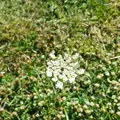
920,723 records of the plant in gardens, fields and the wild worldwide; most photos come from United States, United Kingdom, Canada, Germany, and France.








Carrot care by growth stage
Open ground
| Stage | Watering | Temperature | Feeding |
|---|---|---|---|
| Germination | every day | 13…18 °C | — |
| Growth | every 3 days | 13…24 °C | nitrogen, 42 days into the stage |
| Harvest | every 7 days | 0…24 °C | — |
At home
| Stage | Watering | Temperature | Feeding |
|---|---|---|---|
| Germination | every day | 13…18 °C | — |
| Growth | every 3 days | 13…24 °C | nitrogen, 42 days into the stage |
| Harvest | every 4 days | 13…24 °C | — |
Growing notes
Light
Needs full sun, at least 6 hours of direct light a day, ideally 8–10.
Soil
Deep, loose, well-drained soil without stones or clods, pH 6–6.8. Stones, heavy clay and fresh manure make roots forked or misshapen; in heavy soil grow short-rooted varieties.
Care
Sow 0.5–1 cm deep where the carrots will grow, as transplanting makes forked roots. Keep the surface moist until the seedlings appear, which takes 2–3 weeks. Thin to 5–7.5 cm apart. Give about 25 mm of water a week, evenly, since dry spells followed by heavy watering crack the roots. A single light nitrogen feed about six weeks after emergence is enough; too much nitrogen spoils the roots.
Pests and diseases of Carrot
7 problems are recorded for carrot; each has a page with symptoms, treatment and prevention.
Carrot: all pests and diseases with photos
Diseases
Pests
- Carrot fly: Rusty-brown scars and tunnels ringing the tap roots, making them inedible.
- Leaf Miner
- Wireworms
Carrot companion plants: good and bad neighbours
Each pair has a source and an evidence level: many companion-planting tips are tradition, not research.
What to plant with carrot?
- Onion (research-backed): In a UK trial, rows of onions among carrots cut carrot fly attack, but only while the onions were young and leafy — once they bulbed the effect was nearly gone (Uvah & Coaker, 1984). A Finnish trial found only a slight effect (Varis, 1991). Sources: doi:10.1111/j.1570-7458.1984.tb03422.x, journal.fi
- Lettuce (practical reason): WSU Extension’s rule for companions is to pair root systems that don’t compete — its own example is deep-rooted carrots with shallow-rooted lettuce. Sources: pubs.extension.wsu.edu
- Radish (practical reason): Radishes come up in a few days and mark the row of slow-germinating carrots; they are pulled long before the carrots need the room (University of Maryland Extension). Sources: extension.umd.edu
- Tomato (practical reason): Carrots do not like heat; Oregon State Extension suggests growing them next to tomato plants, which give them shade in summer. Sources: extension.oregonstate.edu
Other plants of the Apiaceae family
Carrot belongs to Apiaceae; 8 other plants of this family have a guide here.
 Parsnip
 Florence fennel
 Celeriac
 Celery
 Cilantro
 Parsley
 Dill
 Lovage
Plant lists it is in
Sources
Figures checked against these sources.
- gbif.org/species/3034742
- en.wikipedia.org/wiki/Carrot
- uk.wikipedia.org/wiki/Морква
- ru.wikipedia.org/wiki/Морковь
- es.wikipedia.org/wiki/Zanahoria
- extension.usu.edu/yardandgarden/research/carrots-in-the-garden
- extension.colostate.edu/resource/vegetable-planting-guide/
- extension.umd.edu/resource/growing-carrots-home-garden
- extension.wvu.edu/lawn-gardening-pests/gardening/wv-garden-guide/growing-carrots-in-west-v
- extension.illinois.edu/gardening/carrots
- rhs.org.uk/vegetables/carrots/grow-your-own
- extension.usu.edu/vegetableguide/root-crops/physiological-problems
- extension.sdstate.edu/carrots-how-grow-it
